 |
|||||||||
|
|||||||||
 |
|||||||||



 |
I.
OPINION
II. EDUCATION
by Douangdeuane Douangdara by Douangdeuane Douangdara by Douangdeuane Douangdara
by Montha Phavongxay by Check Kirivong by Douangchit Mounghane
by Anonymous by Von PhrakonKham by Check Kirivong by Douangdeuane Douangdara by Von PhrakonKham
by Douangdeuane Douangdara by Von PhrakonKham by Von PhrakonKham by Douangdeuane Douangdara by Sounantha Phoumarath
by Von PhrakonKham
by Douangchit Mounghane
by Montha Phavongxay by Douangchit Mounghane |
The
Story of Lao New Year
By Douangdeuane Douangdara
Lao New Year is derived from the lunar system.
The moon changes from Rasy Mes to Rasy Minh between April 13-16th. The
Lao, Thai, Khmers and Burmese, who believe in the lunar system, celebrate
their New Year during this time. Old time folks used to worship Phra Phrome
"The Lord of all Angels." They prayed to him during times of trouble and
illness.
Then later, a boy named Thao Thammabane Koumane was born to a rich family
in Praranasy City. He acquired
many skills from the top schools and grew up to be a young and clever
man. One special skill he possessed was his ability to 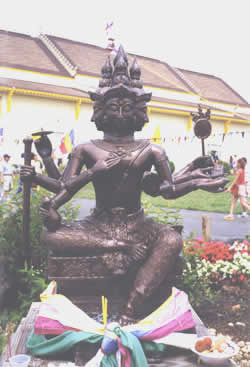 communicate
with animals. When word of his wit and special skills traveled, town folks
began turning to him for advice and healing.
communicate
with animals. When word of his wit and special skills traveled, town folks
began turning to him for advice and healing.
When Phra Phrome learned why people stopped praying to him, he got very
upset. He challenged Thammabane to a debate. He would ask Themmabane three
questions. If Themmabane could not answer them, he would be beheaded as
a sacrifice to Phra Phrome. However, if Thammabane is successful, Phra
Phrome would sacrifice his head to Thammabane's intelligence. The questions
were:
In the morning, where do people shine?
In the afternoon, where do people shine?
In the evening, where do people shine?Thammabane was clueless to the answers, but was quick in his thinking and suggested that the debate be made open to public witness. To buy time, he suggested they wait seven days to allow people to gather in the stadium and celebrate the winner. Phra Phrome agreed.
Five days had passed and Thammabane still could not figure out the ridddle. By the sixth day, he accepted his loss and opted to flee to avoid the shame he would experience after his reign as the country's most intelligent. He walked all day in the sun and into the forest. As the passed, he over heard the animals gossiping about his loss and attempted to ignore them. As night fell, Thammabane became exhausted and fell into a deep sleep under a big tree. The birds chattering woke him, and Thammabane eavesdropped on their conversation. The female bird asked her partner "Honey, where are we going to look for our food today?" The male bird replied, "We don't have to go far today because our food will be available as the sun comes up. Either Thammabane or Phra Phrome will lose their head on a bet." The lady bird was anxious and repeatedly asked, "What kind of bet would be worth loosing a head for?" The male bird could no longer resist her persistence, and told her about the riddle and the answers.
Thammabane was very happy to learn the answers and walked back to the city confident with his head held high. When he walked into the stadium, people cheered and clapped. He sat next to Phra Phrome and answered the riddle with a smile:
In the morning, people shine their face; we wash our faces in the mornings.
In the afternoon, people shine their chest; we take a bath and scrub our chest in the afternoons.
In the evening, people shine their feet; we wash our feet before entering the bed at night.Phra Phrome felt his loss and called upon to his seven daughters to bring the gold tray to catch his head. Due to his spiritual power, if his head falls on the land, he predicted the country shall experience a serious drought; if it falls into the sea, there shall be a flood; and if it falls in the fire, there shall be a serious fire devastating the country. To avoid these catastrophes, his head must be caught on the gold tray and kept in the Khanthaboury Cave at the Kayrath Mountain; it must be held sacred, perfumed with potion and adorned with flowers. Every year when the moon changes from Rasy Mes to Rasy Minh, each of his daughters would take turns inviting all the angels to come pay respect to his sacrificial head. This ritual included a parade circling the Kayrath Mountain three times. If these rituals were conducted, the country would find fortune and blessings.
Commentary
This year 2546, Phra Phrome's daughter Nang Khorakhathave is on duty. In Luangprabang, we used to celebrate our new years as follows: On the last day of the old year (Sangkhane Louang), we host a festival in the market in the mornings. Everybody is dressed in their best, and the rich adorn themselves with all their jewels. It was easy to observe who had more or less at that time. At home, we would clean the house to a shine. Later in the afternoon would attend the head of Phra Phrome parade where all the beautiful angels walked from Wat Xiengthong to Wat Thad (from north to south). Then at night, we would attend the temple to cleanse Buddha.
The middle day (Nao), we would again shop at the festival market. By noon, we would head up to the Moungkhoune Island to make sand castles and set free birds and fish. Some head up the Color Mountain to Zieng Pra and count the steps. At Wat Visoune they had Poo Gneu Gna Gneu and Sing Kap Sing Khone, believed to be our ancesters dancing to the beat of the drums. At night we would again visit the temple seeking Budhha's blessing.
On New Year's Day (Sangkhane Kheune), we would cook our traditional larb (spicy meat salad) for good luck. We would host a Baci ceremony and ask for forgiveness and blessing from our parents and the elderly. In the afternoon, some would head up to Ting Cave where many Buddhas were kept for thousands of years. In the town of Nang Sangkhane, (named after one of Phra Phrome's daughter) the Phra Phrome head parade was held, where his daughters and angels carried his head back from Wat Thad to Wat Xiengthong (south to north). At night was the best part of our New Year's celebration. We would sit on the green lawn of the royal palace to watch monkeys carry lit lanterns, walking down the Color Mountain steps into the palace. Also, there was a traditional play in which Nang Keo, Nang Sida and Pra Luck Pra Lam danced with their swords. So this is the tale behind our Lao New Year's celebration. Savat Dee Pee Mai (Happy New Year)!

| make a donation to Lao Vision |
Questions? Comments? about this site, please email webmaster@laovision.net
| © 2003 Lao Vision Magazine | [ tevadesign ] |