 |
|||||||||
|
|||||||||
 |
|||||||||



 |
I.
OPINION
II. EDUCATION
by Douangdeuane Douangdara by Douangdeuane Douangdara by Douangdeuane Douangdara
by Montha Phavongxay by Check Kirivong by Douangchit Mounghane
by Anonymous by Von PhrakonKham by Check Kirivong by Douangdeuane Douangdara by Von PhrakonKham
by Douangdeuane Douangdara by Von PhrakonKham by Von PhrakonKham by Douangdeuane Douangdara by Sounantha Phoumarath
by Von PhrakonKham
by Douangchit Mounghane
by Montha Phavongxay by Douangchit Mounghane |
By Jennifer Neria and Douangchit Mounghane
Whether you are fresh out of college, or have been working for several years-graduate school becomes a question for many. What is the motivation to return to school? What does it involve in terms of money, time, and effort? How do I decide where to go and what to study? How is it different from my undergraduate experience? What are my options? How will I pay for it?
Likely these are the questions that have been looming in your mind if you're one of the many who are considering graduate school. Let's look briefly at the decision to go to graduate school and the graduate school experience…
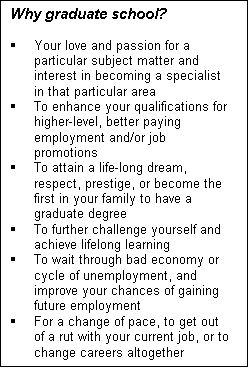
Reasons for going to graduate school
There are many reasons for considering graduate school. If you're just out of college, perhaps you're interested in a field that you already know requires a higher-level degree to land a job. Or, maybe you feel that your college education was too broad and you'd like to continue your training and specialize in an area are you are good at and enjoy. These reasons not only enable you to challenge your intellect and expand your knowledge, but they also lead to another common reason for wanting to go to graduate school: to become better qualified for higher-level and often better paying jobs. A graduate degree can also qualify you for certain job promotions at your current workplace.
However, there are other reasons why people decide to return to school. Maybe you're in a job or career field that you've learned just isn't for you. If this is the case, graduate school offers an opportunity to start anew. Maybe you're an engineer, but have always enjoyed cooking and after working a few years, you would like to pursue your hobby as a profession and become a chef.
What is a graduate degree really worth anyhow? Well, the answer lies within the beholder. Will the recipient use this specialized training or not and if so, how? Shall we measure its worth based on its earning power? What about relative scarcity and demand for professionals with these degrees? When you review the statistics, only about 5% of our American population 25 years and older hold a masters level degree, and only about 1% hold a doctorate degree. But do you need a "practical" reason for wanting to get a graduate degree? Maybe you just need a change of pace, or perhaps you've always dreamt of being the first in your family to attain a graduate degree. These are equally important and common motivations for going to graduate school.
What to expect
So you may ask, "How will graduate school be different from my undergraduate experience?" Well, for one, during your undergraduate education, you may remember being one among many students; you were required to take a variety of classes; you attended your classes, took notes, completed your papers and exams and were done. On the other hand, in graduate school you will share more interest and enthusiasm with your colleagues; you may also notice that the age and experiences of your peers vary more; you will learn both from your colleagues experiences and from your professor's guidance via interactive and discussion-oriented classes verses the traditional didactic lectures; you will most likely be part of small focused classes and seminars and know your professors; you will perform independent work, write a lot more papers, and participate in group projects and presentations; the level of self-discipline required is greater; and to complete your degree you must pass oral and/or written exams in addition to writing and defending a thesis.
Which program and which school?
To make an informed choice about which program and school you should apply to, consider these tips:
1) Assess your interest, skills, and qualifications/competitiveness
2) Gather information:
- Talk to your teachers/professors, advisors, professionals in your field of interest, school alumni, and students attending your program/school of interest
- Research the Internet
- Review books and guides
- Admission requirements
- Program and school reputation and accreditation
- Faculty, availability, and network of professionals
- Cost: scholarship and other financing options
- Size, Location, Diversity
- Degree requirements (semester hours, coursework, internships/rotations, etc.)
- Flexibility: online/distance learning options, time needed to complete degree and maximum years allowed, part time status option, credit transfers, etc.
Depending on your field of study, you will most likely have to take one of the following exams, submit an application and essays, and participate in an interview.
| REQUIRED ENTRANCE EXAMS | FIELD OF STUDY / PROFESSION (degree) |
NOTES/ADDITIONAL RESOURCES |
| GRE Graduate Record Exam | Arts & Sciences (e.g., English, Mathematics,
Physics, etc.) (MA, MS, PhD) Education (MEd, EdD) Nursing (MSN, NP) Psychology (MA, PsyD, PhD) Public Health (MPH, DPH) Social Work (MSW, DSW) |
Paper and computer exams are available. Some graduate schools may require that you take the Miller Analogy Test (MAT), instead. www.gre.org 609-771-7670 |
| GMAT Graduate Management Admission Test |
Business (MBA) | http://www.gmac.com |
| LSAT Law School Admission Test |
Law (JD) | www.best.indiana.edu./LSAT.html 215-968-1001 |
| MCAT Medical College Admission Test |
Medicine (MD) | The American College Testing Program PO Box 414 Iowa City, IA 52243 |
| DAT Dental Admission Test |
Dentistry (DDS) | DAT is administered via computer on almost any day of the year: http://www.ada.org/prof/ed/testing/dat.asp |
Paying for School
Once you have considered the various programs/schools, the application process, and other preparation, you must consider how you will finance your education. The following table is an organization of some types of financial assistance.
| SOURCE | PROS | CONS | TYPES | RESOURCES |
| Scholarships | Do not have to repay | Competitive | -Merit -Athletic -Military/ Veteran -Minority |
www.finaid.org/scholarships/other.html www.fastweb.com |
| Federal & State Aid Programs | -Based on Need -Do not have to repay grants |
-Must have satisfactory progress towards degree -Must be nrolled at least half time -Competitive |
-Grants -Loans -Work Study |
www.fafsa.ed.gov www.nslds.ed.gov/ www.finaid.org http://www.students.gov/ 800-4FED-AID 800-433-3243 Federal and Private/Foundations (civic groups, etc.) |
| SOURCE | PROS | CONS | TYPES | RESOURCES |
| Loans | - Easier to obtain - Grace period is usually 6 months |
- Must repay - Possible interest & fees - Consider caps |
- Federal (Perkins, Stafford) - Private |
Inquire with college financial aid offices, banks, Fannie Mae, etc. www.easi.ed.gov |
| College and Other Agencies | Gain significant hands–on work experience | Work may take valuable time away from your studies | - Work study - Teaching & Research Assistants, Resident Hall - Co-op - Fellowship - Internship - Community Service |
Inquire through your school program |
| Employer | Good for continuing education and acquiring work–related skills | You may be required to pay back your employer shall you leave within
a specified time |
Employee Educational Assistance Package | Ask your employer human resources |
| Savings | May be a great option for tax savings | Requires planning and investment | - Bonds - Trusts - Money Market - Mutual Funds - Education IRA - College CD |
Consult with financial advisor |
Other resources
Unfortunately, there is much more detail to planning your graduate education than what we could include without writing a book, so talk to your advisor, professors, colleagues, professionals in your field of interest, other students; research the Internet; and visit your local library or book store for helpful guidance books, sample entrance exams, and multimedia tools. Below are additional resources for your research. Cheers to higher education and our future leaders!
Library and book stores
US News and World Report. 2004 Edition on America's Best Graduate Schools Peterson's Guides to Graduate Programs The Official Guide to MBA Programs The Official Guide to US Law Schools, Graduate Study in Psychology and Associated Fields Barron's Guide to Graduate Business Schools Barron's Guide to Law Schools Barron's Guide to Medical and Dental Schools Medical School Admission Requirements in the United States and Canada. Veterinary School Admission Requirements in the United States and Canada.
Internet
Search for schools by subject:
http://www.gradschools.com/search.html
Information on a variety of topics-- Undergraduate, Graduate and Professional Study, Postgraduate Executive Education:
http://www.petersons.com/
Links to 2300 universities in 73 countries: http://www.mit.edu:8001/people/cdemello/univ.html
Search Graduate and Professional Schools:
http://www.petersons.com/gradchannel/
Educational Testing Service:
http://www.ets.org/
Directory of graduate programs around the world:
http://www.gradschools.com/

| make a donation to Lao Vision |
Questions? Comments? about this site, please email webmaster@laovision.net
| © 2003 Lao Vision Magazine | [ tevadesign ] |