 |
|||||||||
|
|||||||||
 |
|||||||||



 |
I.
OPINION
II. EDUCATION
by Douangdeuane Douangdara by Douangdeuane Douangdara by Douangdeuane Douangdara
by Montha Phavongxay by Check Kirivong by Douangchit Mounghane
by Anonymous by Von PhrakonKham by Check Kirivong by Douangdeuane Douangdara by Von PhrakonKham
by Douangdeuane Douangdara by Von PhrakonKham by Von PhrakonKham by Douangdeuane Douangdara by Sounantha Phoumarath
by Von PhrakonKham
by Douangchit Mounghane
by Montha Phavongxay by Douangchit Mounghane |
By Montha Phavongxay
One of the most important of Lao customs is the marriage ceremony, called the Baci/Sou Khouan, a tradition that characterizes the uniqueness of the Lao culture. The Sou Khouan is the prime wedding event. Most couples live together and are accepted and acknowledged by their families and society as "husband and wife" once they have gone through the ritual of Sou Khouan, despite the fact many of them may or may not be married under law.
The Sou Khouan appears to have become more of a cheerful formality than just a simple ritual. Aside from performing this ritual at weddings, this kind of ceremony is also performed for other important events such as housewarming, farewell to travelers, greeting family members or relatives after a long absence, births, deaths, honoring achievements, and recovery from illness. Only a few Lao would dare to experience such vital life events without engaging in this ceremony of blessings and well wishing.
It is believed in a traditional Lao marriage ceremony that customs and traditions must be adhered to ensure a happy and long lasting marriage. Also, by having a traditional ceremony, Lao newlyweds demonstrate their respect for and interest in preserving their cultural heritage. Here in the United States, couples may opt for a separate Western wedding at the church or other more casual means to receive their official certificates of marriage. The length of the wedding festivities is determined by the financial means of the families of the bride and groom; however, most last about one day.
Another distinguished aspect of a Lao traditional wedding is how the bride and groom are dressed. The bride’s hairstyle is gathered into a high, clean and tight bun kao phome and decorated with gold chains and jewelry. The brides’ hair takes about two hours to style as no loose strands are allowed. The groom on the other hand has the option to either wear the traditional sarong to match the brides’ sinh or a tuxedo. Most often grooms will wear their sarongs during the Sou Khouan and change into a tuxedo for the reception. Likewise, the bride may change into a white dress.
On the wedding day, the festivities begin with a procession lead by the groom and accompanied by his family and friends from the groom’s to the brides’ home. Music sets a jovial mood for this happy occasion. The groom carries a pair of flowers and lit candles. He and his party arrive bearing gifts negotiated during the engagement ceremony. Here in the United States, most couples do not live as close as they did in their homeland, so often the procession will begin at a closer destination to the bride's home.
The groom must cross symbolic doors before entering into the bride's house. To pass, the groom must offer a gift (i.e. some money to the persons guarding the entrance). The guards ask the groom and his party a series of rhetorical questions: Where did you come from? Who are you? Why have you come here? Have you come in good intentions or do you wish us harm? The groom must politely answer all questions and show proper respect to his prospective in-laws. Before the groom is allowed to enter, the bride’s younger female relative cleanses his feet with water. This act is a symbol of respect and allegiance to the groom–a way to thank the groom for the wedding (most expenses are paid by the groom’s family). Although, now Lao genders are experiencing more equality, thus expenses are often split amongst the two families.
Afterwards, a respected model from the bride’s side, who is experiencing a long and successful marriage places the groom beside the bride and next to two pha Khouan, a ceremonial flora arrangement. Pha Khouan are
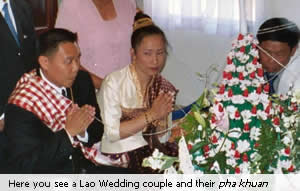 held in bowls of rice and are surrounded with a whole chicken, eggs, fruits,
snacks, and treats as offerings to the khuane (spiritual essence). The elder
guests join the bride and groom and their families around the pha khuan.
held in bowls of rice and are surrounded with a whole chicken, eggs, fruits,
snacks, and treats as offerings to the khuane (spiritual essence). The elder
guests join the bride and groom and their families around the pha khuan.
In Laos, Pha Khouan are made out of fresh banana leaves, cut and folded into a cone shape, and inserted with fresh flowers. Here in the United States, when banana leaves are unavailable, they are substituted with green art paper, and sometimes silk flowers replace fresh flowers.
The Sou Khouan is conducted by a Mor Phon(literal: "mor" -doctor, in this case spiritual doctor; "phon" -blessing) , an elder in the community who is knowledgeable of Buddhism and traditional Lao rituals. He is a person with special status in the Buddhist temple who can officiate at well-wishing ceremonies such as the Baci or Sou Khouan, and can interpret the Buddhist calendar. The Mor Phon knows the correct order of events in the wedding ceremony, and recites verses of Buddhist scripture in pali, the language of Buddhism.
After the Mor Phon finishes his chant, he gives the newlyweds a small amount of rice, egg, and alcohol spirits. Drinking of the spirits symbolizes wealth for the new couple; the rice and egg symbolizes their humble past. Then, the Mor Phon continues with another chant for the new couple.
Following the chants, the Mor Phon ties the wrists of the groom and the bride with a white cotton string. This is called phouk khene. As he ties the string, he gives blessings to the couple. Next, the guests (mainly the elders) join in the phouk khene to offer well wishes to the couple. Once everyone has had their turns, the bride and groom return to their original sitting arrangements and the Mor Phon ends the Sou Khouan, and guests are invited to dine.
As the guests enjoy their traditional Lao meal, the bride and groom filter through their guests to extend gratitude in celebrating their union. This expression of thanks is demonstrated by offering a shot of liquor [Drink with us on this happy occasion]. In return the guests present envelopes of money as gifts for the new couple to begin their lives together.
At every wedding there is always dancing, and a Lao weddings are no exception. The bride and groom are the first to take the floor and dance the traditional lam vong. Then on the second dance,
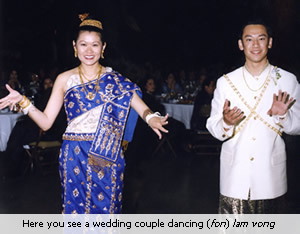 the
parents of both parties are asked to join the bride and groom. Finally,
the rest of the guests join them. The lam vong travels in a circular
motion; the men dance in the interior portion of the circle, while the women
dance on the peripheral. The hand motions in lam vong include a
dexterous and circular motion–tender, elegant, inviting, then gentle
and teasingly rejection. The men and women do not touch as they dance. Traditionally,
the men initiate the dance by asking the women by raising his palms together
almost like a traditional greeting gesture called noap. However,
in today’s modern times, you may also observe women initiating dances.
At the end of the dance, dancers noap each other as a symbol of
respect and thanks.
the
parents of both parties are asked to join the bride and groom. Finally,
the rest of the guests join them. The lam vong travels in a circular
motion; the men dance in the interior portion of the circle, while the women
dance on the peripheral. The hand motions in lam vong include a
dexterous and circular motion–tender, elegant, inviting, then gentle
and teasingly rejection. The men and women do not touch as they dance. Traditionally,
the men initiate the dance by asking the women by raising his palms together
almost like a traditional greeting gesture called noap. However,
in today’s modern times, you may also observe women initiating dances.
At the end of the dance, dancers noap each other as a symbol of
respect and thanks.Lao weddings involve intricate details, a history of customs, and some master planning as they often include a large guest list of hundreds and even thousands! Best of luck to the next couple planning their wedding! Here’s a friendly reminder: consult your elders for dates of good omen and give yourself a lot of planning time. After all, a traditional Lao wedding is bound to become a community event and is no longer just your own wedding!

| make a donation to Lao Vision |
Questions? Comments? about this site, please email webmaster@laovision.net
| © 2003 Lao Vision Magazine | [ tevadesign ] |